

“Can I stay? Please?” Thomas pleaded.
These words, along with his sweet, pleading eyes, stay with me. I think of those eyes every time he looks at the clock and realizes it is time to leave his classroom for Academic Intervention Services (commonly known as AIS reading). Thomas is reading 2 grade levels behind and has spent the majority of his elementary school years leaving the classroom each day for tier II reading instruction. He is not alone.
I have heard many administrators lament over the revolving AIS door where students come in and out of tier II and III services. The high number of students reading below grade level keeps them up at night. They are aware that classroom and reading teachers are not always aligned in their instruction, leaving AIS students to navigate separate curricula—a heavy lift for any student, but especially for those who are our most vulnerable readers and writers. They think about how so many systems in schools live in the space of “This is how we have always done things” and consider: What if we imagine another way?
Seven years ago, I started documenting another way; a connected and collaborative approach to Multi Tiered Systems of Support (MTSS). As a reading teacher at the time, I wrote about how classroom teachers and I partnered to:
Assess and analyze our shared students’ data.
Identify students’ strengths and needs based on academic standards.
Plan instruction connecting tiers I, II and III to build on students’ strengths and meet their needs.
Reflect on student progress and plan next steps.
I have pages detailing what this looked like and how we got there but for now, I offer a few first steps for school leaders to consider bringing to their schools.
Step 1: Identity shared beliefs
I will be honest, this is messy and will require guidance and research to back up pedagogy that yields student academic achievement. However, it is essential. The purpose is not to place blame on any teacher or curriculum. It is to create a baseline and build towards a shared vision of what is possible.
***Remember, at the end of the day, I am willing to bet that every teacher in your building cares about kids and wants them to achieve academic success and feel a sense of wellbeing. Start there!
Step 2: Engage in professional learning together.
Teachers and administrators need to have a vision for what is possible and consider literacy frameworks, instructional methods and materials to support student literacy achievement. This requires ongoing professional learning about instructional methods that yield student success.
Step 3: Create a shared vision for MTSS
Shared beliefs are the foundation for professional learning. Once you have that, you can build your school- based vision for MTSS.
What could it look like?
What curriculum and materials will teachers use?
How will you know if it is working?
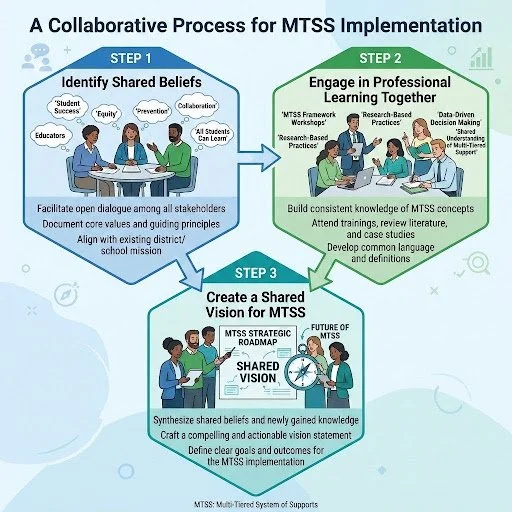
Three step process for a collaborative approach to MTSS
Sustaining the work
Once you build a model, your team will need guidance to sustain it. This includes two parts:
Shared data collection and analysis - Informal hallway conversations between classroom teachers and literacy specialists about student progress are not enough to drive meaningful gains in student achievement. Teachers need opportunities to analyze data together, identify trends and create a profile of each child. This requires an initial investment of time but subsequent meetings will be brief.
Ongoing collaborative planning - Have classroom teachers and literacy specialists look closely at the tier I curriculum. Name the most essential academic standards of each unit and brainstorm ways to link that work to tier II and III. Consider which strategies can be addressed in each setting. If tier I focuses on informational texts, ensure that students receiving tier II and III services have opportunities to read text in the same genre during their AIS time.
Finally, I’ll offer one concrete, micro-move to ease teachers into this process…
Have teachers co-create a bookmark that students can carry to each tier of reading instruction that details strategies for figuring out words.
Yes, this requires some thinking about beliefs and knowledge of best practices but it is a concrete first step in signaling a shift to a more collaborative approach to academic intervention.